
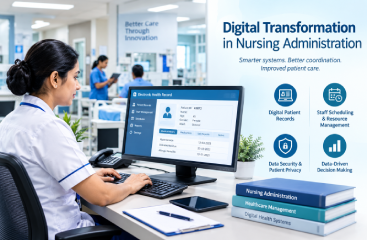
Digital Transformation in Nursing Administration: Enhancing Efficiency, Leadership, and Patient Care
Introduction
Digital transformation is reshaping healthcare organisations by changing how information is managed, teams are coordinated, and patient care is delivered. In nursing administration, digital technologies provide opportunities to improve workforce planning, streamline administrative processes, strengthen communication, and support evidence-based decision-making.
Nursing administrators play an important role in managing nursing staff, coordinating clinical services, monitoring care quality, maintaining records, and ensuring that institutional policies are followed. As healthcare systems become increasingly complex, traditional administrative processes may not always provide the speed, visibility, and coordination required for effective management.
Digital tools such as electronic health records, staff scheduling systems, digital dashboards, and data analytics can help nursing leaders make better-informed decisions. However, successful digital transformation requires more than adopting new software. It involves preparing staff, improving workflows, protecting sensitive information, and ensuring that technology supports rather than replaces professional judgement.
1. Understanding Digital Transformation in Nursing Administration
Digital transformation in nursing administration refers to the integration of digital technologies into administrative processes, nursing management, communication, and quality monitoring.
It involves reviewing existing workflows and using appropriate technologies to make them more efficient, transparent, and reliable.
Key applications include:
- Electronic health records and digital nursing documentation.
- Digital staff scheduling and workforce management.
- Nursing performance and quality dashboards.
- Electronic reporting and administrative record systems.
- Digital communication and coordination platforms.
- Data analytics for operational planning.
- Online training and professional development systems.
- Telehealth coordination and remote-care support.
The objective is not simply to convert paper records into digital formats. It is to improve the way nursing services are organised, monitored, and continuously developed.
2. Electronic Health Records and Digital Nursing Documentation
Electronic health records (EHRs) enable authorised healthcare professionals to record, access, and update relevant patient information through digital systems.
For nursing administrators, these systems can support better coordination, documentation oversight, and access to information needed for operational decisions.
Digital nursing documentation may include patient observations, care plans, medication-related records, clinical handovers, and other information appropriate to the nursing role.
When implemented effectively, electronic systems can improve record accessibility, reduce certain forms of duplication, and support continuity of care.
However, digital documentation must be accurate, timely, and completed according to established clinical protocols. Institutions should provide appropriate training, access controls, audit trails, and downtime procedures to manage technical disruptions.
Patient information must be handled confidentially and accessed only by authorised personnel for legitimate purposes.
3. Digital Workforce Planning and Staff Scheduling
Managing nursing staff is one of the most important responsibilities of nursing administration. Appropriate staffing helps healthcare facilities maintain service continuity, distribute workloads, and respond to changing patient needs.
Digital workforce management systems can help administrators organise duty rosters, monitor staffing availability, manage leave requests, and identify scheduling conflicts.
Depending on the system, administrators may also review staffing patterns across departments and compare workforce availability with operational requirements.
For example, a hospital may use a digital scheduling platform to identify a shift with insufficient staff and arrange appropriate cover according to institutional policies and staff competencies.
These tools can improve administrative visibility and reduce the time spent coordinating schedules manually.
Nevertheless, automated scheduling should not replace professional assessment. Staffing decisions must consider patient acuity, required competencies, applicable staffing norms, staff well-being, and the needs of individual clinical units.
4. Data Analytics for Nursing Decision-Making
Healthcare organisations generate substantial amounts of information through patient records, staffing systems, incident reports, and quality-monitoring processes.
Data analytics can help nursing administrators identify patterns, understand operational challenges, and prioritise improvement activities.
Useful indicators may include:
- Nursing staff availability and workload patterns.
- Training and competency completion.
- Patient-care documentation compliance.
- Falls and other relevant safety incidents.
- Infection-prevention indicators.
- Patient feedback and service concerns.
- Overtime and staff turnover patterns.
Dashboards can present selected indicators in a clear format, allowing administrators to review trends and identify areas that require attention.
For example, a repeated increase in missed training sessions or documentation gaps may prompt a review of workload, training access, or administrative procedures.
Data should always be interpreted in context. A single indicator rarely explains the full situation, and performance measures should not be used without considering patient complexity, staffing conditions, reporting practices, and other relevant factors.
5. Improving Communication and Coordination
Effective communication is essential to nursing administration. Nursing teams need reliable ways to share duty information, communicate policy updates, coordinate clinical activities, and escalate concerns.
Approved digital communication platforms and hospital information systems can support timely information-sharing between nursing departments, administrators, doctors, and other healthcare professionals.
Digital handover tools and structured reporting systems may also help teams communicate relevant information consistently.
However, institutions must establish clear rules about which platforms may be used for clinical communication, what information can be shared, and how urgent concerns should be escalated.
Sensitive patient information should not be shared through unauthorised applications or personal accounts. Digital communication should strengthen established clinical communication procedures rather than create additional confusion.
6. Supporting Patient Safety and Quality Improvement
Patient safety remains a central responsibility of nursing administration. Digital systems can support quality monitoring by making selected records, incident reports, and performance indicators easier to review.
Depending on their design, systems may provide reminders, flag missing information, or help authorised staff monitor compliance with relevant protocols.
Nursing administrators can use this information to identify recurring problems, coordinate corrective action, and evaluate whether improvement initiatives are working.
For instance, a review of incident reports may reveal a recurring problem with clinical handovers. The administration team could respond by reviewing the handover process, providing targeted training, and monitoring subsequent results.
Digital alerts and automated checks are not infallible. They can produce false alerts or miss important issues. Staff must understand their limitations and continue to apply clinical judgement and established safety procedures.
A constructive quality-improvement culture should focus on learning, accountability, and prevention rather than relying only on numerical performance targets.
7. Artificial Intelligence in Nursing Administration
Artificial intelligence (AI) and advanced analytics may support selected administrative activities, such as summarising authorised operational information, identifying patterns in staffing data, and helping organise routine administrative tasks.
When appropriately validated, these technologies may assist administrators in reviewing information and identifying areas for further investigation.
For example, an analytics system might highlight recurring staffing gaps across certain shifts, prompting nursing leaders to review workforce allocation and service requirements.
However, AI-generated recommendations may be inaccurate, incomplete, or influenced by limitations in the data used. Nursing administrators should verify outputs before making decisions that affect staff, patients, or clinical operations.
AI should not independently determine high-impact staffing decisions, replace professional accountability, or make clinical judgements without appropriate oversight.
Any implementation should include data protection measures, clear accountability, human review, and regular evaluation of system performance.
8. Digital Training and Professional Development
Digital transformation also creates opportunities to improve the professional development of nursing staff.
Online learning platforms can provide access to approved educational materials, policy updates, refresher courses, and continuing professional development activities.
Simulation tools and virtual learning resources may support training in clinical procedures, emergency response, communication, and patient safety.
Nursing administrators can use learning management systems to coordinate training schedules, track completion, and identify staff who require additional support.
However, completion records alone do not prove competence. Practical skills should be assessed through appropriate demonstrations, supervised practice, and role-specific competency evaluations.
A strong digital training strategy combines accessible learning resources with practical experience, faculty support, and continuous assessment.
9. Challenges in Digital Transformation
Although digital technologies offer significant opportunities, nursing institutions and healthcare organisations may face challenges during implementation.
Infrastructure and cost
Digital systems require suitable hardware, software, reliable connectivity, technical support, and ongoing maintenance. Institutions should consider long-term costs rather than focusing only on initial installation.
Resistance to change
Staff members may be concerned about unfamiliar workflows, increased documentation, or the possibility of technology making their work more difficult. Early consultation, practical training, and responsive support can help address these concerns.
Data privacy and cybersecurity
Healthcare information is sensitive. Organisations must implement appropriate access controls, secure authentication, backups, staff awareness, and incident-response procedures.
Data quality and interoperability
Incomplete records, inconsistent formats, and systems that cannot exchange information effectively can reduce the usefulness of digital tools. Clear data standards and appropriate integration planning are important.
Overdependence on technology
Technical failures can interrupt administrative and clinical processes. Institutions need documented downtime procedures and safe methods for continuing essential operations.
Staff training and workload
Digital systems may initially add to staff workload if they are poorly designed or introduced without adequate preparation. Implementation should include workflow testing, feedback, and adjustments.
Addressing these challenges requires leadership, planning, staff involvement, and continuous evaluation.
10. The Role of Nursing Leaders in Digital Transformation
Nursing leaders are essential to the successful adoption of digital technologies. They connect institutional goals with the practical needs of nursing teams and help ensure that new systems improve real workflows.
Their responsibilities may include:
- Identifying administrative problems that technology could address.
- Involving nursing staff in system selection and implementation.
- Coordinating training and technical support.
- Establishing clear procedures for digital documentation and communication.
- Monitoring system performance and staff feedback.
- Promoting privacy, cybersecurity, and responsible data use.
- Reviewing outcomes and making improvements where necessary.
Effective leaders communicate the purpose of change, listen to staff concerns, and ensure that digital systems support safe patient care.
Digital leadership also requires a willingness to learn. Nursing administrators need not become software engineers, but they should understand the capabilities, limitations, and risks of the systems they oversee.
11. Digital Transformation in Nursing Administration in India
India’s healthcare system includes public and private hospitals, medical colleges, nursing institutions, community health services, and facilities serving diverse populations.
Digital transformation can support improved coordination and information management across these settings, provided that solutions reflect local infrastructure, staffing, connectivity, and operational needs.
Initiatives such as the Ayushman Bharat Digital Mission aim to develop a connected digital health ecosystem. Nursing administrators should understand relevant digital health developments and the requirements that apply to their own institutions.
Potential priorities include improving digital documentation, strengthening authorised information-sharing, developing staff digital literacy, and establishing consistent administrative reporting practices.
Implementation must account for data privacy, cybersecurity, accessibility, interoperability, and the applicable legal and regulatory framework.
Digital transformation should be adapted to institutional needs rather than pursued simply to follow technological trends.
12. Measuring the Success of Digital Transformation
The success of a digital initiative should be measured by its practical impact, not merely by the number of systems installed.
Nursing administrators can assess outcomes using indicators such as:
- Time required to prepare and update duty rosters.
- Completion and accuracy of relevant nursing documentation.
- Staff participation in digital training.
- Frequency of workflow errors or duplicated administrative tasks.
- Timeliness of reporting and communication.
- User feedback and system usability.
- Progress on selected patient-safety and quality indicators.
- System reliability and response to technical incidents.
Baseline measurements should be established before implementation wherever practical. Results can then be compared over time to determine whether the system is producing the intended benefits.
Evaluations should consider staff experience, patient safety, data quality, and unintended consequences alongside efficiency.
13. A Practical Roadmap for Implementation
Healthcare organisations can approach digital transformation through a structured and gradual process.
Step 1: Assess current workflows. Identify administrative delays, repeated manual tasks, communication gaps, and information-management challenges.
Step 2: Set clear objectives. Define the specific improvements expected from the proposed digital system.
Step 3: Select suitable technology. Evaluate usability, cost, security, interoperability, and relevance to nursing workflows.
Step 4: Involve nursing staff. Seek feedback from people who will use the system in daily practice.
Step 5: Provide training. Ensure that administrators and nursing teams understand how to use the technology safely and effectively.
Step 6: Implement in phases. Begin with a suitable department or workflow, where possible, and resolve problems before wider implementation.
Step 7: Monitor outcomes. Review performance indicators, staff feedback, technical issues, and any effects on patient care.
Step 8: Improve continuously. Update processes and training based on evaluation findings.
This approach helps organisations reduce avoidable disruption and ensure that technology adoption remains focused on practical improvements.
Conclusion
Digital transformation is creating new opportunities to strengthen nursing administration through improved documentation, workforce planning, communication, data analysis, and quality monitoring.
However, technology alone cannot guarantee efficient administration or safe patient care. Successful transformation depends on capable leadership, trained staff, reliable infrastructure, responsible data management, and a commitment to continuous improvement.
Nursing administrators must ensure that digital systems support professional judgement, protect confidential information, and respond to the real needs of patients and healthcare teams.
By combining digital innovation with effective leadership and compassionate nursing practice, healthcare organisations can build more coordinated, efficient, and responsive nursing services.
Digital transformation is most valuable when technology empowers nursing professionals, strengthens decision-making, and improves the quality and safety of patient care.