
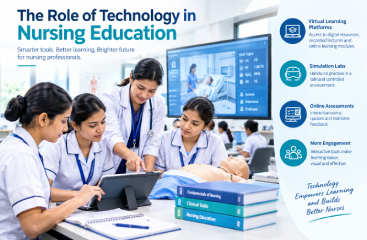
The Role of Technology in Nursing Education: Transforming Learning for Better Patient Care
Introduction
Technology is transforming the way healthcare is delivered, managed, and taught. In nursing education, digital tools and innovative teaching methods are creating new opportunities for students to understand complex concepts, practise clinical skills, and prepare for real-world healthcare responsibilities.
Traditional classroom teaching remains important, but nursing students also benefit from digital learning platforms, simulation laboratories, virtual learning resources, electronic health records, and interactive educational tools. When used effectively, these technologies can make learning more engaging, accessible, and closely connected to modern clinical practice.
The integration of technology into nursing education is not simply about introducing computers or digital devices. It is about improving the learning experience, strengthening clinical competence, encouraging critical thinking, and preparing future nurses to deliver safe, ethical, and patient-centred care.
1. Understanding Technology in Nursing Education
Technology in nursing education refers to the use of digital systems, educational software, simulation equipment, and other innovative tools to support teaching, learning, clinical training, and assessment.
These technologies help educators present information in different formats and allow students to explore topics beyond traditional textbooks and lectures.
Examples include:
- Digital learning management systems.
- Online classes, webinars, and educational videos.
- Virtual simulation and clinical skills laboratories.
- Electronic health record training systems.
- Digital libraries and online research resources.
- Interactive quizzes and computer-based assessments.
- Virtual reality and augmented reality learning tools.
- Artificial intelligence-assisted educational applications.
The selection of technology should depend on learning objectives, available resources, faculty expertise, and the needs of students. Technology is most valuable when it supports meaningful learning rather than being used only for its novelty.
2. Digital Learning Platforms and Online Education
Digital learning platforms have expanded the ways nursing students can access educational materials. Through learning management systems, educators can share lecture notes, presentations, recorded lessons, assignments, reading materials, and practice assessments.
Students can revisit difficult topics at their own pace, revise lessons before examinations, and access additional learning resources outside the classroom.
Online classes and webinars can also connect students with educators, researchers, and healthcare professionals from different institutions. This can create opportunities for knowledge-sharing that may otherwise be difficult to arrange.
However, digital learning requires reliable internet access, suitable devices, digital literacy, and appropriate faculty support. Nursing institutions should consider students with limited connectivity and provide alternative learning arrangements wherever possible.
A blended learning approach, combining classroom teaching with digital resources and supervised practical training, can help institutions balance flexibility with the hands-on requirements of nursing education.
3. Simulation-Based Learning and Skills Laboratories
Simulation-based learning is one of the important applications of technology in nursing education. It enables students to practise selected clinical procedures and respond to simulated patient situations in a supervised learning environment.
Depending on the available resources, simulation may use task trainers, mannequins, computer-based scenarios, virtual patients, or high-fidelity simulators.
Students can practise patient assessment, vital-sign monitoring, emergency response, communication, teamwork, and clinical decision-making without exposing real patients to the risks associated with inexperienced practice.
For example, a simulated scenario involving a patient whose condition suddenly deteriorates can help students practise recognising warning signs, communicating concerns, and following appropriate clinical protocols.
Educators can provide feedback, review student decisions, and allow students to repeat scenarios to improve performance.
The World Health Organization has published guidance on simulation training in nursing and midwifery education, highlighting simulation as an educational strategy for developing knowledge and practical skills.
Simulation should complement appropriate clinical placements and supervised patient-care experience, not automatically replace them.
4. Virtual Reality and Augmented Reality
Virtual reality (VR) and augmented reality (AR) offer additional ways to make nursing education interactive.
Virtual reality can place learners in computer-generated environments where they explore anatomy, practise selected clinical scenarios, or experience simulated healthcare settings. Augmented reality can overlay digital information onto the physical environment to support visualisation and learning.
These tools may help students understand complex anatomical structures, practise clinical decision-making, and explore situations that are difficult to recreate during ordinary classroom teaching.
For instance, a virtual clinical scenario may allow students to assess a simulated patient, identify relevant information, and decide which actions require further attention.
However, VR and AR systems may require specialised equipment, technical support, and faculty training. Institutions should evaluate whether these technologies provide meaningful educational benefits before making substantial investments.
5. Artificial Intelligence in Nursing Education
Artificial intelligence (AI) is creating new possibilities for personalised learning and educational support.
AI-assisted tools can help students revise concepts, generate practice questions, organise study materials, and explore explanations of difficult topics. When appropriately designed and supervised, these tools may support independent learning and provide additional opportunities for practice.
For example, a student learning about patient assessment could use an educational application to review a simulated case, identify relevant observations, and compare possible responses with guidance from a qualified educator.
Nevertheless, AI tools can produce inaccurate, incomplete, or misleading information. Students must verify important information using reliable textbooks, clinical guidelines, approved educational materials, and qualified faculty members.
AI should not replace professional teaching, clinical supervision, or independent critical thinking. Nursing students must learn to evaluate information carefully and understand that clinical decisions require appropriate assessment, professional judgement, and adherence to established protocols.
Patient-identifiable information and confidential institutional records should never be entered into unapproved AI tools.
6. Electronic Health Records and Nursing Informatics
Digital healthcare systems are increasingly important in modern clinical environments. Nursing students therefore need opportunities to understand electronic health records (EHRs), digital documentation, patient information systems, and the principles of nursing informatics.
Training with suitable educational systems can help students learn how to document patient observations, review relevant information, understand care plans, and communicate within healthcare teams.
Nursing informatics also introduces students to data accuracy, information security, confidentiality, and the responsible use of digital systems.
These skills can help prepare graduates for healthcare environments where accurate documentation and effective information management are essential.
Educational systems should use appropriate safeguards and simulated or authorised data. Students must understand that access to real patient information is governed by confidentiality, privacy, and institutional policies.
7. Improving Teaching Methods and Faculty Effectiveness
Technology can support nursing educators in presenting complex information more clearly and developing varied learning activities.
Videos, interactive diagrams, digital presentations, online quizzes, and case-based learning resources can supplement lectures and help students engage with difficult concepts.
Educators can also use digital assessment tools to identify topics that students find challenging and adjust teaching accordingly.
However, effective technology integration requires more than purchasing equipment. Faculty members need training in digital teaching methods, instructional design, online assessment, simulation facilitation, and the evaluation of educational resources.
Institutions should encourage educators to share successful teaching approaches, evaluate new tools, and select technologies that support clear learning outcomes.
The educator remains central to the process: technology should enhance teaching quality, not replace the guidance, feedback, and mentorship students need.
8. Technology for Assessment and Student Feedback
Digital assessment systems can help educators evaluate student understanding through quizzes, online tests, case studies, and structured assignments.
When designed appropriately, these systems can provide timely feedback and help students recognise areas that require further study.
Technology can also support the organisation of clinical skills assessments, competency checklists, and learning progress records.
For practical competencies, digital tools should be combined with direct observation and appropriate assessment by qualified educators. A student answering questions correctly does not necessarily demonstrate the ability to perform a clinical procedure safely.
Assessment should therefore evaluate both theoretical knowledge and practical competence, along with communication, professionalism, and clinical reasoning.
9. Benefits of Technology in Nursing Education
When appropriately selected and implemented, technology can support several aspects of nursing education.
Greater access to learning: Digital resources can make educational materials available beyond scheduled classroom sessions.
Interactive learning: Simulations, visual resources, and case-based activities can encourage active participation.
Repeated practice: Simulated scenarios allow students to practise selected skills, receive feedback, and improve.
Development of digital competence: Students gain familiarity with technologies relevant to modern healthcare settings.
Support for critical thinking: Well-designed clinical scenarios encourage learners to assess information, consider alternatives, and explain their decisions.
Flexible learning opportunities: Blended approaches can supplement classroom instruction and accommodate different learning needs.
Improved feedback: Digital assessment tools can help identify learning gaps and guide further study.
The actual benefits depend on the quality of implementation, the learning objectives, access to resources, and the way technology is integrated with teaching and supervised practice.
10. Challenges in Implementing Educational Technology
Despite its potential, technology integration presents challenges that nursing institutions must address.
Infrastructure and affordability
Computers, simulation equipment, software, reliable internet, and technical maintenance can require significant investment. Institutions should prioritise resources according to educational needs and available budgets.
Faculty training
Educators may require additional support to use digital platforms, simulation equipment, and AI-assisted tools effectively.
Unequal access
Students may have different levels of internet access, device availability, and digital literacy. Inclusive planning is essential to avoid widening educational inequalities.
Information security and privacy
Educational platforms and digital systems must protect student information and any patient data used in authorised learning activities.
Reliability of digital information
Online resources and AI-generated explanations may contain errors. Students must be taught to verify information using trusted sources.
Balancing technology with practical experience
Nursing requires direct patient interaction, hands-on skills, empathy, and professional judgement. Digital learning must be integrated with supervised practical education rather than treated as a complete substitute.
Addressing these challenges requires careful planning, appropriate policies, staff development, and ongoing evaluation.
11. The Role of Nursing Institutions in Digital Transformation
Nursing institutions have an important responsibility to ensure that technology supports educational quality and professional competence.
Institutional leaders can begin by identifying the learning needs of students and faculty, reviewing available infrastructure, and selecting tools that align with the curriculum.
Practical steps include:
- Establishing reliable digital learning platforms.
- Strengthening nursing skills and simulation laboratories.
- Training faculty in technology-supported teaching.
- Integrating digital health and nursing informatics into relevant learning activities.
- Providing guidance on responsible AI use and information verification.
- Protecting student information and maintaining patient confidentiality.
- Evaluating the effectiveness of digital tools through student feedback and learning outcomes.
- Ensuring that technology-supported learning complements required clinical training.
Institutions should also follow applicable Indian Nursing Council, university, and other relevant regulatory requirements when designing and delivering nursing programmes.
A phased implementation strategy can help institutions introduce technology sustainably while maintaining educational standards.
12. The Future of Technology in Nursing Education in India
India’s nursing education system serves students and healthcare communities with varied needs, resources, and infrastructure. Technology can create opportunities to expand access to educational resources and strengthen the preparation of future nursing professionals.
Digital learning, simulation-based education, virtual learning environments, and nursing informatics can support more interactive and competency-focused educational approaches.
Technology may also facilitate collaboration between nursing colleges, hospitals, educators, and professional organisations through webinars, shared learning materials, and faculty development programmes.
However, progress requires attention to affordability, connectivity, faculty readiness, language accessibility, data privacy, and the availability of appropriate clinical training.
The Indian Nursing Council’s published curriculum materials recognise simulation, competency-based learning, and nursing informatics as relevant elements of nursing education. Institutions should consult current official curriculum and regulatory documents when implementing specific programmes.
The goal should not be to make nursing education entirely digital. It should be to combine the strengths of technology with practical experience, human interaction, professional ethics, and compassionate care.
13. A Practical Roadmap for Technology Integration
Nursing institutions can adopt a structured approach to technology integration.
Step 1: Identify educational priorities. Determine which subjects, clinical skills, or learning activities would benefit most from technology.
Step 2: Assess available resources. Review infrastructure, equipment, internet connectivity, software, and faculty capabilities.
Step 3: Train educators and students. Provide practical instruction on the selected tools and establish clear usage guidelines.
Step 4: Introduce appropriate tools. Begin with relevant resources, such as digital learning materials, online assessments, or selected simulation activities.
Step 5: Integrate practical learning. Connect digital lessons with skills laboratories, clinical demonstrations, and supervised placements.
Step 6: Evaluate outcomes. Review student performance, practical competence, feedback, accessibility, and the value of the investment.
Step 7: Improve continuously. Use the findings to update teaching methods, strengthen support, and refine the technology strategy.
This approach helps ensure that technology adoption remains purposeful, sustainable, and focused on educational outcomes.
Conclusion
Technology is becoming an important part of modern nursing education. Digital learning platforms, simulation-based training, virtual learning tools, electronic health record systems, and artificial intelligence can create new opportunities to strengthen knowledge, clinical preparation, and digital competence.
However, technology alone cannot produce skilled and compassionate nurses. Its success depends on qualified educators, meaningful practical training, reliable resources, responsible implementation, and a strong commitment to professional ethics.
Nursing institutions must use technology thoughtfully, ensuring that innovation complements the human aspects of nursing and prepares students for the realities of healthcare practice.
The future of nursing education lies in combining technological innovation with clinical competence, critical thinking, and compassionate care to prepare nurses for a safer and more effective healthcare system.